
Westmoreland VINELink Release Coverage
VINELink is the public entry point for Virginia VINE. For Westmoreland County, the local adult-jail path is Northern Neck Regional Jail in Warsaw. The system can supply custody status, agency or facility, and status-change information that NNRJ sends to the service. Virginia materials describe notices for release, transfer, escape and return, and death. Search and registration are available through the web service or by calling 1-800-467-4943.
Virginia separates the local and state stages. A person transferred from NNRJ to a VADOC prison did not enter the community, even if the local record reports a release event. The VADOC locator is the public state search. Eligible victims and immediate family use a separate state notification program called NAAVI. VINELink also does not cover a federal BOP sentence or serve as a permanent court-record archive.
Search Westmoreland VINELink Records
Use a known offender or booking ID when the interface offers it. An ID reduces the risk of mixing two people with the same name. If only a name is available, compare the agency and other displayed identifiers. Do not treat one unmatched spelling as proof that the person was released or never held.
- Open VINELink and select Virginia.
- Choose “Search for an Offender,” then enter the full name or available offender ID.
- Open only the record whose identifying details and agency match the Westmoreland custody event.
- Read the custody status, agency or facility, and event timestamp exactly as displayed.
- If the result says released, confirm whether the person entered the community or moved to another agency.
Try supported name variants when needed, such as a full middle name or suffix. Keep the search narrow. The Westmoreland County release search gives the wider confirmation path when VINE is silent or ambiguous.
The official VINELink entry screen captured for the Westmoreland release pages shows where the Virginia person search and notification process begins.
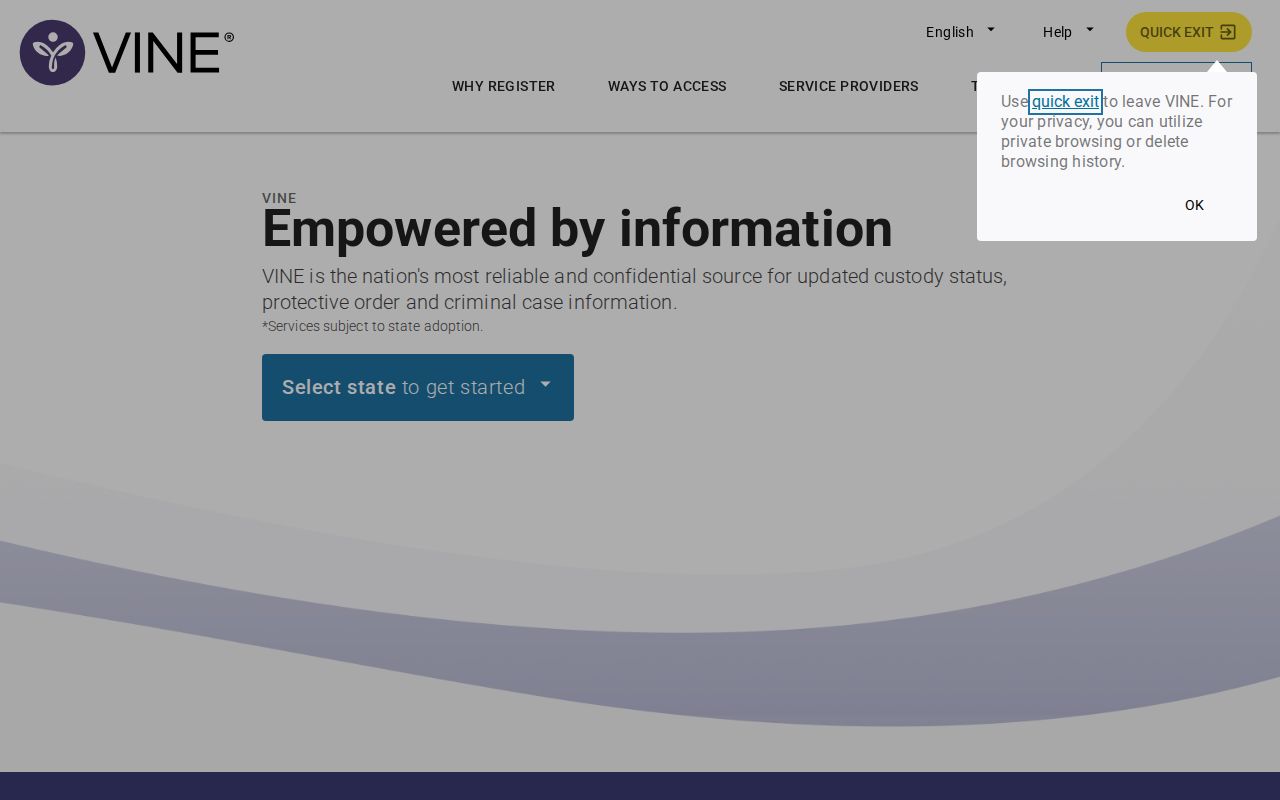
The screen is an entry point, not evidence about a particular person. Use the record returned for the correct agency and verify its timestamp.
Westmoreland VINELink Release Fields
The exact live labels can change, and not every participating agency supplies the same fields. Read only what the returned record states. A status-change message is useful near the event because it is driven by agency data, but it does not replace the NNRJ out-transaction or the court order.
| Field | What it can establish |
|---|---|
| Name or offender ID | Helps match the intended person; an ID is stronger than a common name. |
| Custody status | The status supplied by the participating agency at the shown time. |
| Agency or facility | Identifies which custody episode the message concerns. |
| Event or update | Reports a release, transfer, or other change as supplied. |
| Notification record | Shows registration or delivery details available to the registrant. |
VINELink is strongest for a recent event. For an older Westmoreland County release, a court docket and NNRJ release-record request are more durable. A projected state-prison date belongs to VADOC and remains forward-looking until the status and signed release documents confirm departure.
Register Westmoreland Release Alerts
Registration can be anonymous for local-jail VINE. Virginia supports phone, text, email, and TTY channels. Choose the correct person before adding a destination. A notification is tied to the record and agency selected, so a namesake error can produce alerts about someone else.
- Select “Get Notified” on the matched VINELink record.
- Choose phone, text, email, or TTY and enter the requested contact destination.
- For telephone calls, create a PIN. Save it with the registration details.
- When the automated call arrives, listen to the message and enter the PIN followed by the pound sign to confirm receipt and stop repeats.
- Keep the confirmation, and check the named agency if the message does not explain the destination.
The TTY line documented by Virginia is 1-866-847-1298. Registering for VINE does not replace a formal notification request required by a court, jail, or VADOC process. Under Virginia Code § 53.1-133.02, a local sheriff or superintendent has separate notice duties for requesting victims in certain sentences longer than 30 days. That statutory notice is not a public recent-release list.
Confirm Westmoreland VINELink Releases
VINE depends on participating-agency data. A delay does not change the legal or physical event. If a person is absent or the status appears stale, use the source that performed the event. NNRJ's roster checks current custody and warns that a recent booking or release can lag. Staff can address a specific release at (804) 250-1750 or provide the roster fallback at (804) 333-6419, within disclosure limits.
For a state transfer, search the VADOC Inmate and Supervisee Locator. A prison facility means continued confinement. A district office can mean community supervision. For federal prison, use the BOP locator. If immigration custody is suspected, use ICE's locator and ask NNRJ whether another agency received the person. VINE is not the federal search.
A court order can explain why release was authorized. It still does not prove the jail completed its paperwork, cleared every hold, and recorded departure. For durable proof, request the NNRJ release date and time, release authority, and receiving-agency notation if releasable.
Note: A VINELink alert identifies an agency-reported change; it does not establish innocence, case closure, sentence discharge, or freedom from all custody.
Westmoreland VINE to NAAVI Handoff
Virginia requires a practical notification handoff when a Westmoreland County person moves from NNRJ into state custody. Local VINE registration does not migrate to VADOC NAAVI. An eligible victim or immediate family member must complete the state program's registration process after the transfer. Missing that second step can leave a gap even though the person remains within Virginia corrections.
NAAVI may notify eligible registrants about anticipated release, often around 30 days ahead, and update that notice when a date changes. It can also cover actual release, transfer, work release, escape and recapture, death, name change, parole interview, and the decision. Help is available at 1-800-560-4292. NAAVI excludes probationers, parolees, and local-jail inmates, which is why it cannot simply replace VINE.
The public VADOC locator remains the general state lookup. NAAVI is an eligibility-based notification service. Neither is the signed Order of Release. Keep the event source clear: local VINE for the NNRJ stage, NAAVI for an eligible VADOC stage, and direct records for lasting proof.
Missing Westmoreland VINELink Results
A no-result can come from a spelling mismatch, the wrong state or agency, reporting lag, a local-to-state transfer, or a custody system outside VINE. Search again with an identifier when one is known. Then move to the NNRJ call, Westmoreland court docket, VADOC locator, BOP locator, or ICE locator according to the case.
Do not describe a missing result as “released.” A precise statement is that no matching VINELink record was located using the stated name or ID at the time checked. That wording preserves the difference between an observation and a custody conclusion. Record the agency and search time so a later check can be compared accurately.
Westmoreland VINE Event Evidence
The strongest proof comes from the agency that carried out the event. An executed NNRJ release transaction is stronger evidence of physical departure than a court order alone. The court order explains the legal authority, but jail staff must receive it, clear holds, return property, and record the out-event. VINE sits between these sources. It is timely and useful, yet it depends on NNRJ's data feed.
When a notice arrives, save the exact wording, time, and reporting agency. Ask whether the event was a community release, transfer, escape and return, or another status change. A notice from NNRJ describes the NNRJ episode. It does not rule out immediate reception by VADOC, USMS, ICE, or another jail. If that distinction matters, request the receiving-agency or transfer notation with the actual release time.
Westmoreland General District Court handles misdemeanor, traffic, and felony preliminary matters. Circuit Court handles felony trials and sentences. A docket can show bond, disposition, active or suspended time, and probation. It may explain the VINE alert while still lacking the exact physical checkout time. Juvenile JDR records are not publicly searchable online, and adult VINE steps must not be used to bypass that confidentiality.
Westmoreland Phone Alert Practice
Telephone registration needs a PIN because the automated system repeats calls until receipt is confirmed. Entering the PIN and pound sign tells VINE that the intended recipient heard the notice. Keep the PIN private but accessible. A disconnected line, full voicemail box, spam filtering, or changed email address can break delivery even when the custody feed works.
VINE should never be the sole safety plan. Virginia's rights card says enrollment does not replace formal registration with VADOC or some jails. Keep direct agency contacts and case information available. For NNRJ, use the main number when the public roster fails and the specific release-day line for timing. For a state stage, complete NAAVI registration when eligible and use VADOC for public custody or supervision status.
A notice can arrive after the actual event because of processing or transmission time. State the alert timestamp separately from the court-order date and the actual release date. Those labels prevent a delayed message from being mistaken for a delayed departure.
Review the matched record when contact details change. A new phone number or email address does not automatically replace the old destination. If the person transfers to a new participating agency, check whether a new notification registration is needed. Keep only the information required to recognize the correct person and event, and rely on the official agency for a correction when the VINE entry appears wrong.