
Westmoreland Projected Versus Actual Release
A projected date estimates when a sentence may permit release under the facts currently recorded. An actual release date records the completed custody event. VADOC's official NAAVI detail uses the label “Projected Release Date.” That field can move as credits, jail time, discipline, warrants, detainers, or court orders change. It cannot be restyled as proof that a person departed.
A pretrial detainee at Northern Neck Regional Jail usually has no sentence-based release date. Release may depend on bond, a later hearing, dismissal, or another order, plus NNRJ's processing and hold checks. A sentenced local inmate may have a computed date held by NNRJ. A state-responsible prisoner may have a VADOC computation. Those are different records.
The calendar passing a projected date proves nothing by itself. Always read status and location with the date. Keep the original source label with every copied date.
Find Westmoreland Projected Release Dates
First decide whether the person is in local, state, federal, or immigration custody. Westmoreland adult local detention is regional through NNRJ in Warsaw. A transfer to VADOC removes the person from the local roster without releasing the person into the community. The Westmoreland County released-inmate search explains that custody handoff in more depth.
- Read the Westmoreland court docket and sentence. Identify whether the matter is pretrial, a local term, or state-responsible custody.
- For state custody, open the VADOC Inmate and Supervisee Locator. Search by VADOC number when known, otherwise use the supported name fields.
- Match identity carefully, then read custody status, location, and the exact release-date label together. Save the access date.
- For a local NNRJ term, call (804) 333-6419 or request the jail's existing time-computation or release record. Do not apply a state calculator to a local sentence.
- If the case is pretrial, use the court order and NNRJ release-day confirmation rather than inventing a projected sentence date.
- On or after the projection, recheck status and seek the executed release record.
VADOC says its locator updates daily and may not always show the latest information. A local-only detainee may never appear there. Federal BOP and ICE records require their own systems.
Virginia Release Credit Systems
Virginia uses more than one time-computation regime. VADOC's Time Computation page distinguishes Good Conduct Allowance, or GCA, from Earned Sentence Credits, or ESC. GCA generally applies to parole-eligible felonies committed before January 1, 1995 and misdemeanors committed before July 1, 2008. Depending on the qualifying combination, VADOC may compute parole eligibility, mandatory parole, and good-time release.
ESC generally applies to felony offenses committed on or after January 1, 1995. The familiar description that a person serves “at least 85%” summarizes the traditional post-1995 structure but is not a safe universal calculator. Under Virginia Code § 53.1-202.3, serious categories can earn at most 4.5 days per 30 days. Other eligible offenses can use levels of 15, 7.5, 3.5, or zero days per 30, subject to classification and rules.
Qualifying pretrial confinement credit is addressed by § 53.1-187. Local jail recordkeeping and written credit policies are addressed by § 53.1-116. NNRJ's specific written computation policy was not found online, so its staff must answer an individual local calculation.
The official VADOC page lays out the GCA and ESC categories used in a Westmoreland County state sentence.
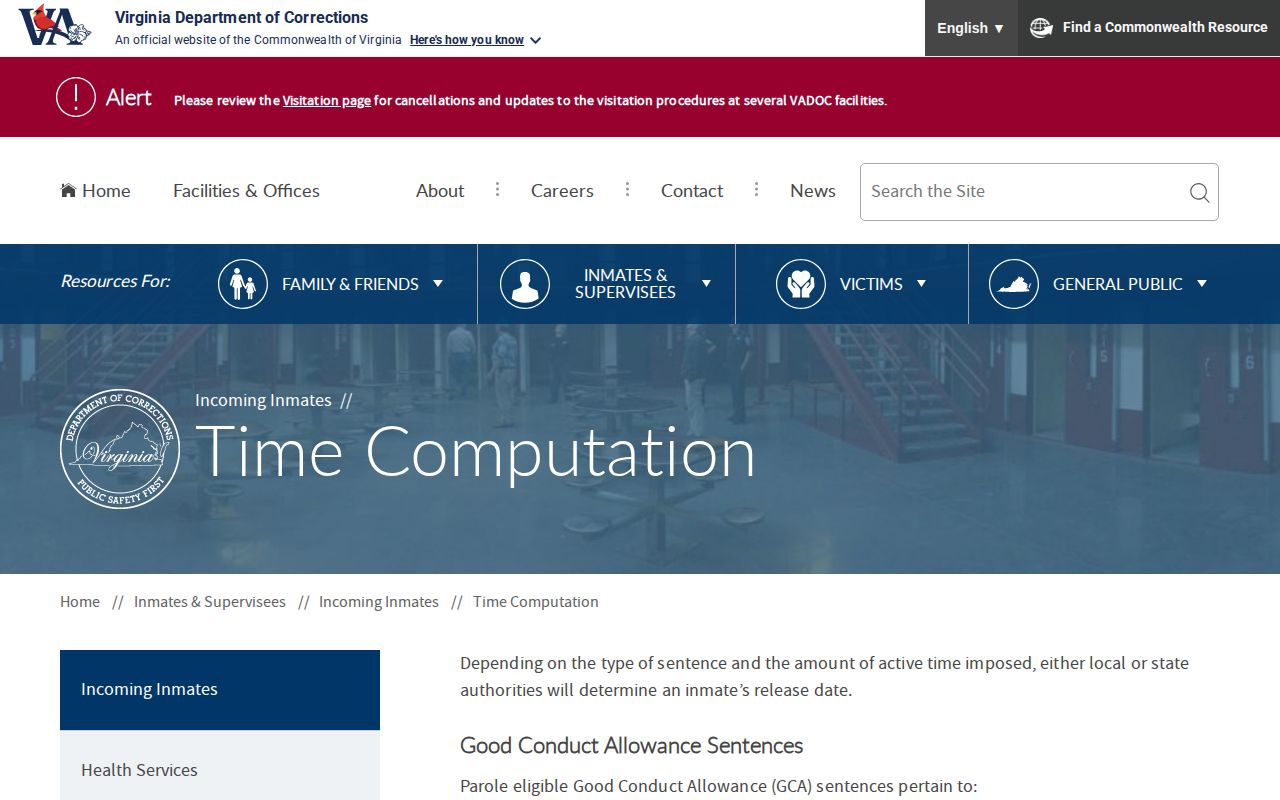
The category definitions guide interpretation, but the correctional authority calculates the individual date from the full record.
Why Westmoreland Release Dates Change
A projected date is recalculated from the sentence information held by the responsible authority. Even a correct display can change later. VADOC performs a final check of warrants, detainers, and time before release. The agency's release procedure, not a copied date, controls the event.
| Factor | Possible effect |
|---|---|
| Prior jail credit | Verified qualifying confinement can alter time remaining. |
| Sentence type and total | GCA, ESC, local, and parole-eligible terms use different rules. |
| Credit earning level | Eligibility and current level affect the rate credited. |
| Discipline | Credit loss or classification change can move the date later. |
| Court amendment | A corrected or new order can change the term. |
| Detainer or warrant | The person may be held for or transferred to another authority. |
| Uncalculated sentence | New or missing sentencing data may require recomputation. |
| Statutory change | Applicable law can change how credits are earned. |
Virginia Code § 53.1-28 permits selection of a discharge day within 30 days for specified administrative circumstances. It is not an automatic 30-day reduction and should never be subtracted by a reader.
Confirm Westmoreland Actual Release Dates
For an NNRJ event, call the release-day line at (804) 250-1750 and ask whether the person physically departed, when, and whether another agency received the person. Staff may limit details. For durable proof, request the booking and release transaction, actual out-date and time, authority, and releasable receiving-agency notation through NNRJ FOIA.
For VADOC, match the locator's updated status to the Order of Release and signed release documents. VADOC procedure stores release documents in VACORIS. A parole grant must also be separated from physical release. The Virginia Parole Board decides parole; VADOC executes the custody event and assigns field supervision when required.
A Westmoreland VINELink check can supply a local custody-change alert. It remains an agency-fed notification rather than the legal release packet. For an eligible VADOC victim notification, registration moves to NAAVI.
Westmoreland Local and State Computation
The authority that computes a Westmoreland County projected release date turns on sentence type and active time. VADOC describes state calculations for active ESC sentences over 12 months and its GCA or parole categories. Local authorities calculate many shorter local sentences. That division is why a general percentage can produce a wrong date.
NNRJ is also a regional facility outside Westmoreland's physical borders. Its current roster can show that someone is confined, but it does not advertise a projected-date archive. Ask for the existing record. A Westmoreland court sentence explains the legal term, while the jail calculation applies credit and custody data.
When a computation seems inconsistent with the judgment, collect the sentencing order, dates of prior confinement, and the exact field displayed by the custodial agency. Ask that agency to review its existing calculation. Do not add credits from separate cases or assume that all time in custody applies to one sentence. A corrected court order or verified credit record can change the projection without changing the original sentence date.
Note: A transfer from NNRJ to VADOC changes the record holder and location; it does not make the local roster disappearance a community release.
Read Westmoreland Release Date Labels
Several dates can appear in one case: booking date, court-order date, parole-decision date, projected release date, mandatory release date, actual out-date, and notification timestamp. Each answers a different question. Record the label and source whenever noting a date. If only a date is published, do not invent a time. Daily locator updates can also make the access date essential when two saved results differ.
The official NAAVI offender detail layout demonstrates the projected-date field used by Virginia corrections.
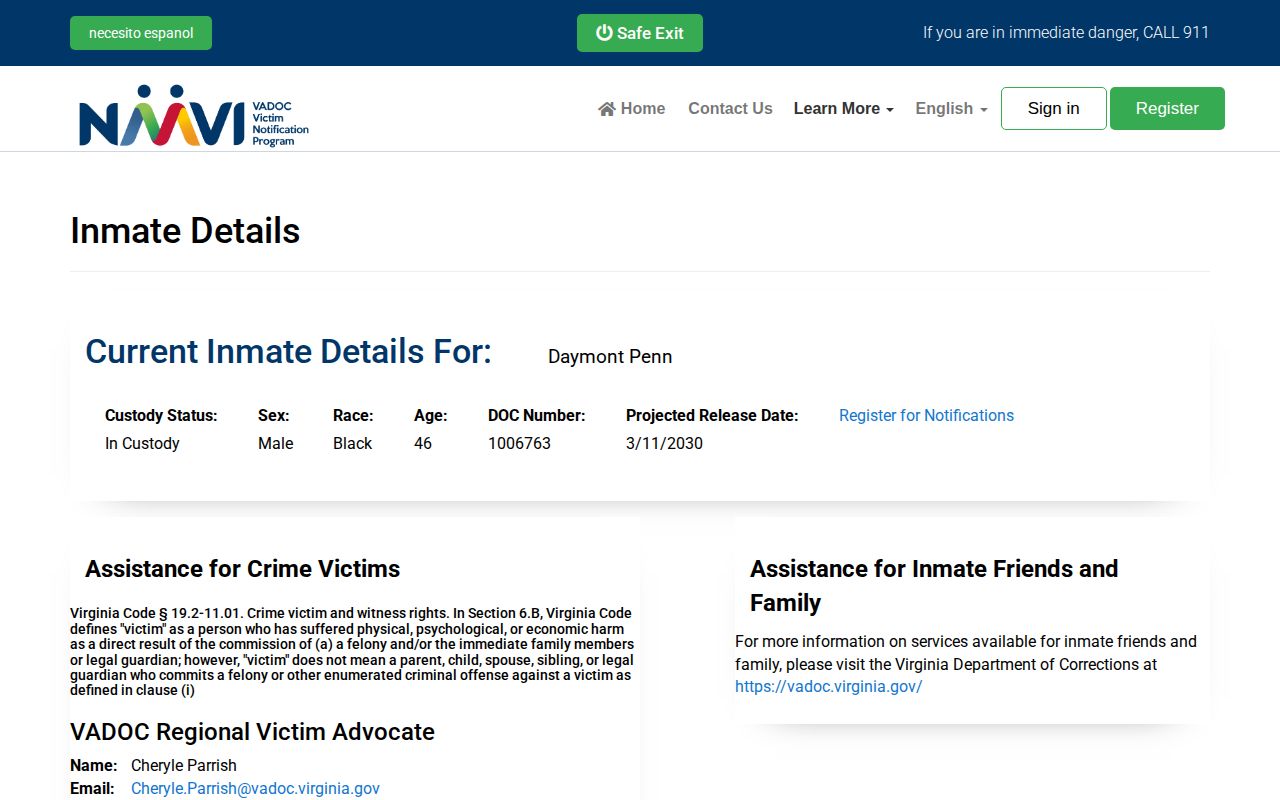
The example is a field-layout reference, not a released Westmoreland County record. The displayed custody status and the date label must be read together.
Westmoreland Parole Date Limits
A parole eligibility date, Parole Board decision date, and physical release date are not interchangeable. The Board's monthly reports can record Grant or Not Grant and a certification date. A grant still requires VADOC execution. Release planning, detainer checks, an approved plan, transport, and final records may separate the vote from the day a person leaves the facility.
Virginia's ordinary discretionary parole was abolished for most felonies committed on or after January 1, 1995, subject to exceptions. Older parole-eligible GCA sentences use rules that can involve parole eligibility, mandatory parole, and good-time release. Virginia Code § 53.1-151 contains commitment-based baselines and many exclusions. No single formula can decide a Westmoreland County case without the offense dates, sentence, and VADOC calculation.
After actual release, District 33 or another assigned VADOC office may appear as the supervision location. That is community status, not continued prison custody. A later discharge ends the described supervision, while a projected prison date merely estimates an earlier event.
Westmoreland Actual Release Packet
A well-supported VADOC release date is tied to the person's DOC ID, court sentence, locator status on the access date, any projected field being discussed, the Order of Release, signed release documents, and the assigned supervision status when applicable. VADOC's facility release process describes discharge and parole paperwork and the day-of-release steps.
For a local NNRJ term, use the jacket or booking identifier, admission date and time, computed local term, actual out-date and time, release authority, and any receiving-agency notation. Add the Westmoreland court order to explain why the release was authorized. The jail record answers physical execution. The court answers legal authority.
The official state release-process capture shows the VADOC source used when a Westmoreland County sentence moved into state custody.
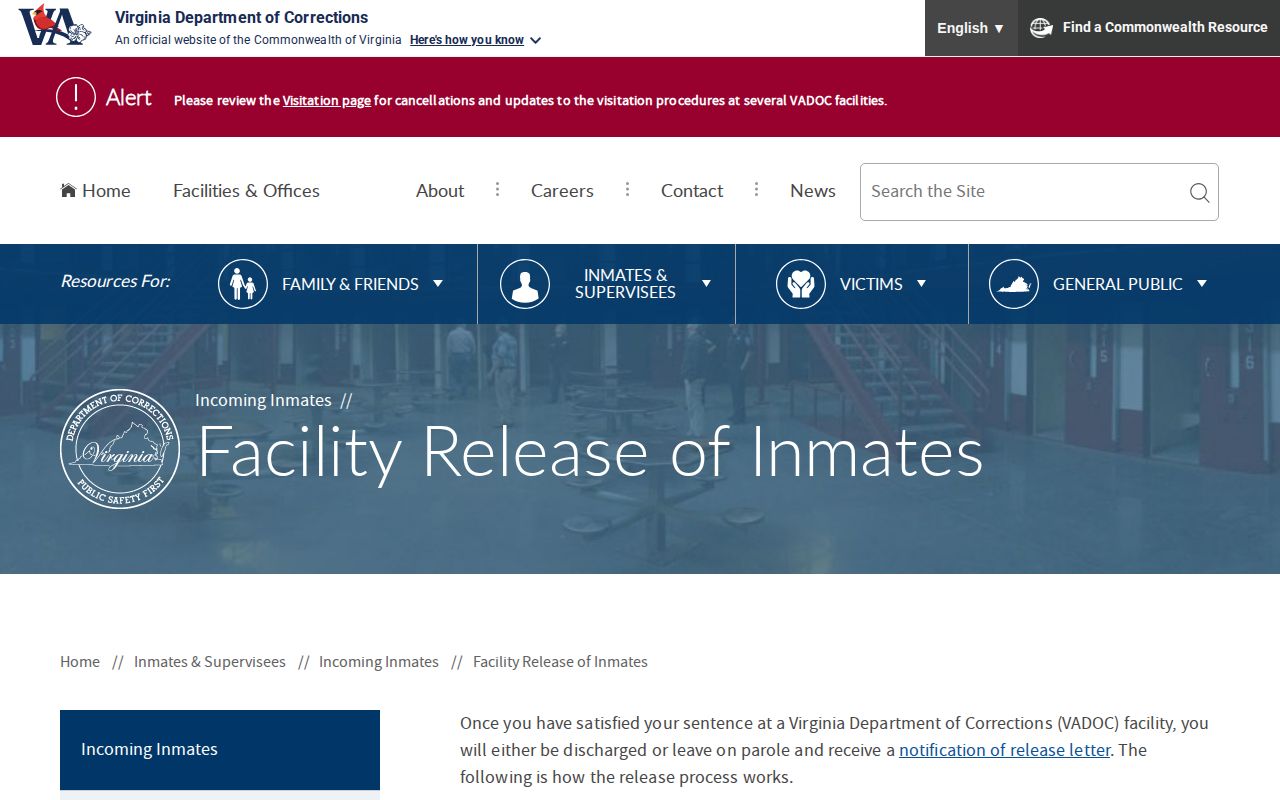
The procedure helps interpret the final record. It does not convert a projected date into a completed release.
Westmoreland Holds and Transfers
A detainer is a request or authority that can keep a person in custody or cause transfer after the current matter ends. NNRJ may hand a person to VADOC, another jail, USMS, or ICE. VADOC also performs final warrant and detainer checks before release. The first facility can accurately record “released” even though the next agency immediately takes custody.
Ask each source a narrow question. The court can explain its own order. NNRJ can identify the physical out-event and, when releasable, the receiving agency. VADOC can explain the state computation and release documents. BOP and ICE answer only their systems. A current-roster disappearance never resolves this chain by itself.
A federal projected date belongs to BOP, while an immigration-custody question belongs to ICE. Neither should be mixed with a Virginia earned-credit estimate. If a person leaves NNRJ under federal authority, PACER or the federal agency record may be needed to explain the next custody step. The same routing protects the difference between a release date from one system and freedom from every system.
Note: Community release, transfer, and discharge are separate outcomes; use the precise label that the executed record supports.