
Northern Neck Release Paths
Northern Neck Regional Jail is the main adult local-custody route for Westmoreland County, even though the jail stands in Warsaw in neighboring Richmond County. A person may leave NNRJ after bond, recognizance, dismissal, time served, completion of a local term, or another court order. Those events can place the person in the community. The same roster departure can instead mark transfer to the Virginia Department of Corrections, another local jail, the U.S. Marshals Service, or ICE. A person serving an intermittent term may also leave between court-set reporting periods.
The destination is therefore part of the release fact. “Released from NNRJ” means the regional jail ended its custody episode. It does not always mean the person entered the community. The jail’s out-transaction best establishes the physical event; a Westmoreland court order explains its legal basis. VINE can add a status-change notice, while the receiving agency establishes continued custody after a transfer.
| NNRJ event | What follows | Best confirmation |
|---|---|---|
| Bond or court release | Community pending the case | NNRJ out-time and court order |
| Local term completed | Community or supervision | Release reason and sentence record |
| State transfer | VADOC custody | Receiving-agency entry and VADOC locator |
| Federal or ICE handoff | Federal custody | NNRJ transfer notation and federal source |
Confirm an NNRJ Release
The official NNRJ roster page searches people currently in custody. It also warns that records update regularly but may not reflect a very recent booking or release. An absent name is thus a prompt for another check, not proof of release. No official NNRJ 24-hour or 72-hour release archive was located in the current navigation or sitemap.
Use a narrow sequence for a recent Westmoreland County event. It separates live status, legal authority, and the final destination.
- Search the current roster by the person’s exact name and reasonable name variants.
- Call NNRJ at (804) 333-6419, or use (804) 250-1750 for a specific release-day question.
- Ask whether the person physically left, when the out-event occurred, and whether another agency received the person.
- Check Virginia VINE for an NNRJ custody-change signal.
- Read the Westmoreland court docket for the bond, disposition, sentence, or commitment order.
- Request the NNRJ release transaction when lasting proof is needed.
NNRJ Release Record Fields
A precise request is more useful than asking for an entire inmate file. NNRJ’s jail-management record can tie the admission to the actual out-event. The court record answers a different question: why the jail was authorized to release or transfer the person. Some security, medical, personal, active-investigation, or other exempt content may be withheld. A requester can ask for the segregable, nonexempt part and the exemption relied upon for any withheld portion.
| Requested field | What it can establish |
|---|---|
| Name and booking or jacket number | The correct custody episode |
| Admission date and time | When the NNRJ stay began |
| Release date and time | The recorded physical out-event |
| Release authority or type | Bond, time served, court order, or other basis |
| Receiving agency | Whether departure was a transfer |
| Hold or detainer disposition | Whether another authority affected release |
| Booking photograph | Identity image tied to that admission |
Virginia FOIA gives a right to request existing public records, not a promise that every field is open. NNRJ states a five-working-day response framework and a possible seven-working-day extension with notice. Actual search, preparation, and copy costs may apply. Asking for an estimate helps keep the request controlled.
NNRJ Records and Contact
The NNRJ FOIA page accepts requests by email, mail, or in person. Give the full name, a useful identifier if known, the approximate admission date, and the exact release fields sought. State whether inspection or electronic copies are preferred. The public-record route is stronger than relying on an old roster capture because it asks the jail that performed the event.
The official NNRJ contact page provides the main office details used to route a release-record question.
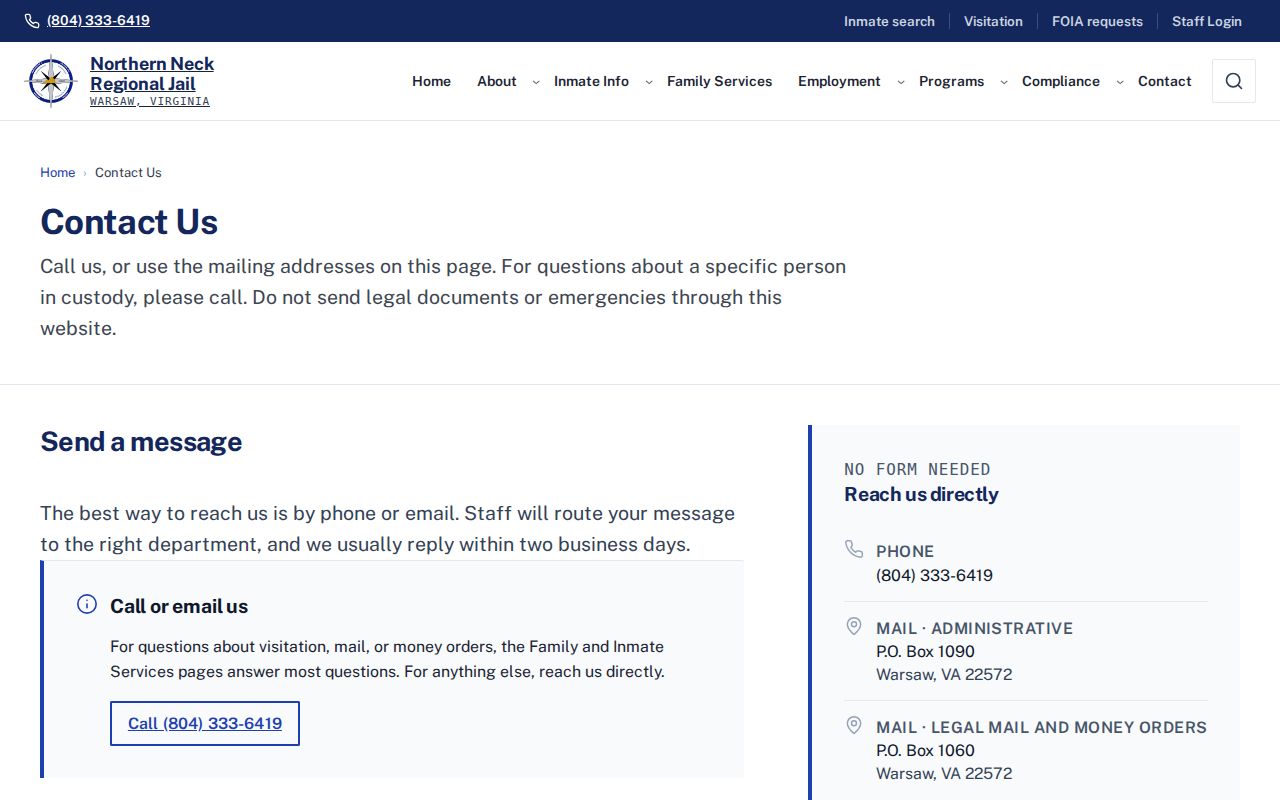
The contact listing supports the facility address and telephone route; the separate FOIA page remains the source for a formal records request.
Northern Neck Regional Jail3908 Richmond Road
Warsaw, VA 22572
Mail: P.O. Box 1090, Warsaw, VA 22572
Main: (804) 333-6419
FOIA Officer Amy Dameron: (804) 333-6016
adameron@nnrj.state.va.us
Monday-Friday, 8:30 a.m.-4:30 p.m.
Request records sufficient to show admission, release date and time, release authority, and a releasable transfer destination. The broader Westmoreland County released-inmate search explains how to reconcile that response with VINE, the court, VADOC, BOP, or ICE.
Note: Ask whether the out-event was community release or agency transfer whenever the destination matters.
NNRJ Release-Day Timing
The NNRJ Family and Inmate Services page does not promise a set release hour. Court paperwork must arrive, staff must process it, and any holds must be addressed. Staff confirms timing for a specific person on the day of release. That direct statement is more reliable than a generic claim that everyone leaves at morning, afternoon, or midnight.
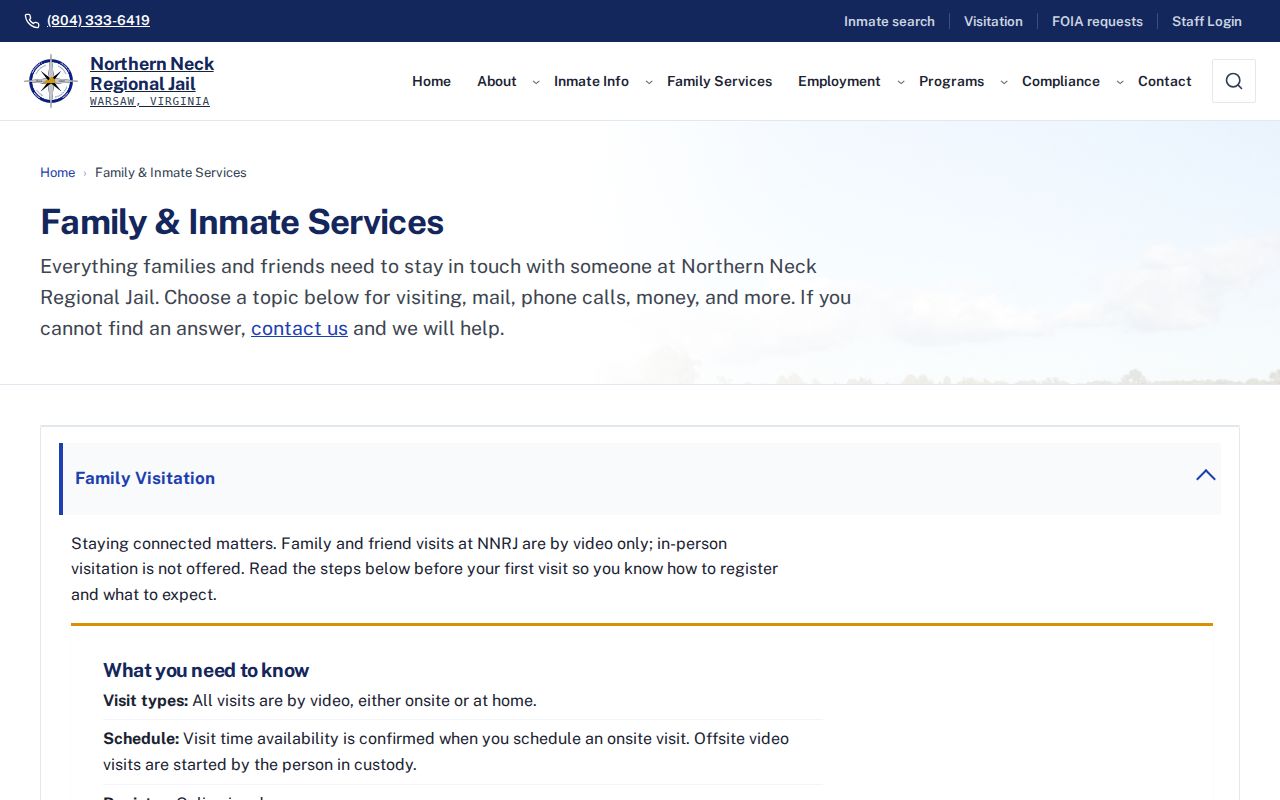
The official release information also says stored property is returned when the person leaves. A remaining account balance is picked up during weekday business hours. These details help explain why a legal order and a completed physical checkout can have different times. No fixed exit door, public waiting point, weekend transport rule, or gate-money payment was verified.
NNRJ Release Planning Services
The Offender Re-Entry and Transition Services program, called ORTS, works with people before release and after return to the community, subject to funding. Enrollment begins with a case manager. NNRJ recommends contact about 90 days before release so there is time to plan.
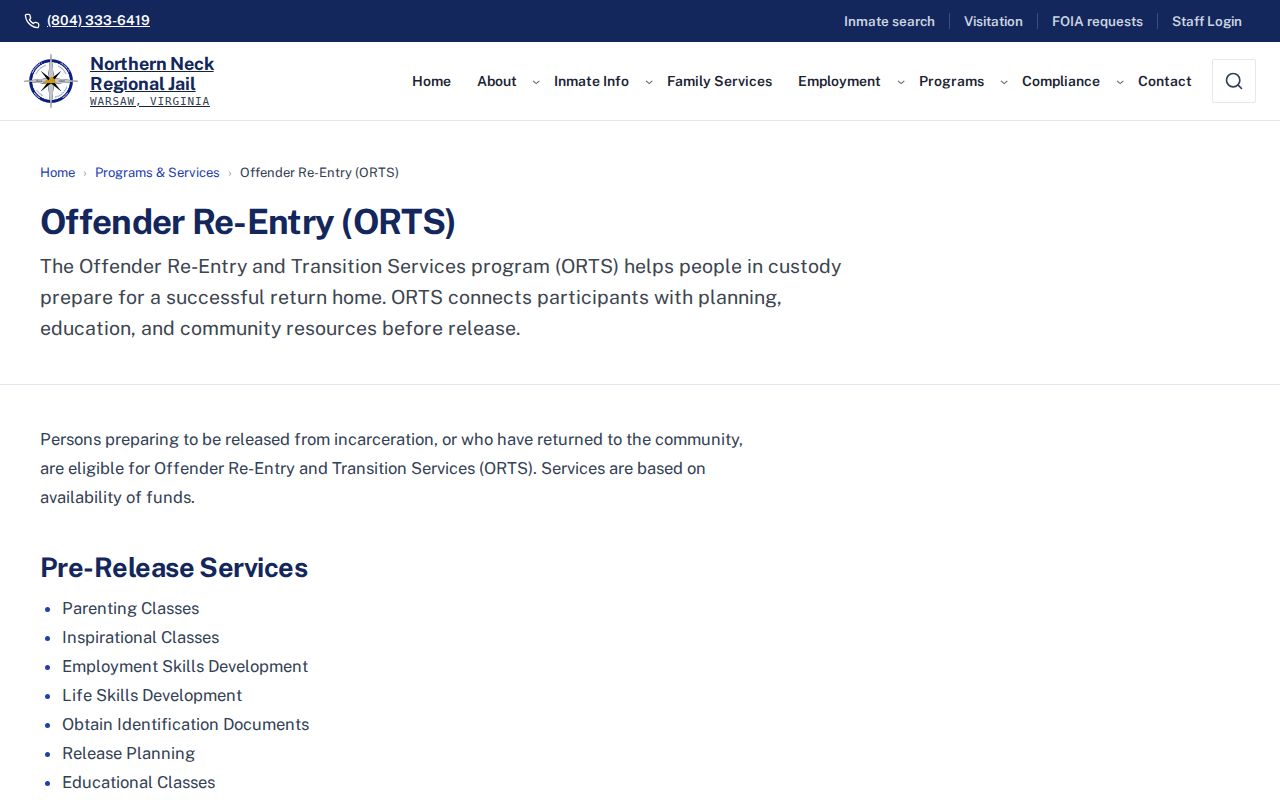
Services may include help with identification documents, education and life skills, transportation, shelter referrals, and links to other agencies. ORTS does not prove that release occurred, set the legal release date, or replace court and jail records. It is a practical release-planning channel tied to this regional jail.
NNRJ Federal Transfer Records
NNRJ’s published agreement with the U.S. Marshals Service permits federal use and provides for release to the committing agency or its designee. That agreement explains a possible custody route. It does not prove that any named person, or any present group, is federally held at NNRJ.
If a Westmoreland County name leaves the NNRJ roster in a federal matter, ask for the receiving agency. A sentenced federal prisoner may later appear in the BOP locator. A USMS pretrial detainee may move between contract facilities without a BOP prison history. An ICE handoff is likewise a transfer, not community release. The NNRJ transfer notation and federal court or agency record must be read together.
Note: Federal authority depends on the case and receiving agency, not merely on the building where a person stayed.
NNRJ Regional Jail History
The official NNRJ history explains why a Westmoreland County custody search points outside the county. NNRJ opened in July 1995 with 198 beds and 42 staff members. A federal-contract expansion in 1996 raised those figures to 268 beds and 74 staff. A 2000 expansion brought the stated capacity to 460 beds and staffing to 100. Northumberland joined the authority in 2000, and Gloucester joined in 2016.
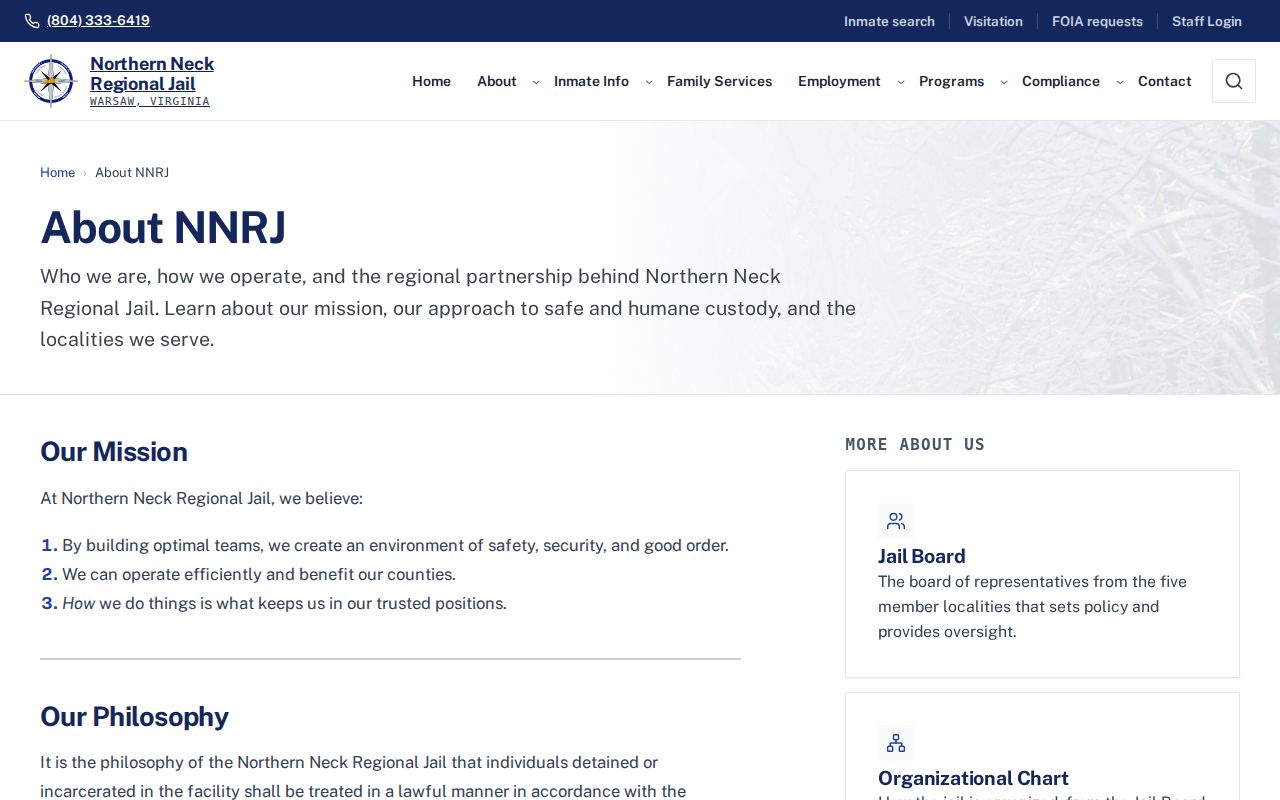
That regional structure is not mere background. It explains why the official local-custody roster and release record bear the Northern Neck name instead of Westmoreland County. It also means location and legal jurisdiction are separate fields. The facility records the stay, while a Westmoreland court may supply the order behind it.
NNRJ Release Evidence Order
When sources conflict, start with the office that performed each event. NNRJ’s executed release transaction is strongest for physical departure. The Westmoreland court controls its bond, disposition, sentence, or commitment order. VINE reports a status signal received through an agency feed. VADOC, BOP, USMS, or ICE controls its later reception or status. This evidence order keeps a delayed notice from overruling the record created by the jail.
Dates need full labels. A court-order date may precede actual release because staff must receive paperwork, clear holds, process the person, and return property. A notification timestamp can follow the physical event. A receiving agency may record admission later still. Preserve each time as supplied, and do not invent one when only a date is public.
Identity needs more than a name. Pair the legal name with the NNRJ booking or jacket number, court case number, approximate admission date, and another lawful identifier when available. Search documented variants when needed, but do not merge two records merely because names match. A precise request should describe one custody episode.
For an older release, begin with the durable court case, then request NNRJ’s admission and release transaction. VINE is most useful near the event and is not a permanent archive. If the transfer points to state or federal authority, add that agency’s record. State the exact system and release type rather than a broad claim about present location.